Bread and butter. It's a classic term that insinuates the basics - what every company should "have at their table." You have your products that are your "bread and butter," which make up the core of your business, but what about the" bread and butter" of your marketing? Do you know your basics there?
Consider the core messages of your marketing that you want to get across. You want to show that you're a thought-leader, a person that everyone should go to for the best products and solutions. Being top of mind and increasing awareness are always the goals of a growing company.
In addition to being a thought-leader, you want to increase your SEO (Search Engine Optimization). You want to drive traffic to your site for people to look at your capabilities and become leads. Let's be honest, the main goal is to increase sales, attendance, or whatever your end-game is to move the needle. By having those keywords and interactive content on your site for your audience, Google and other search engines notice when you get higher traffic and backlinks to your site. The more views to your blog, the more awareness, the more search engines notice, and the more people are on your site that might contact you or buy. See how it all interconnects?
Blogging is a way to get people to that site that you've worked so hard on. It gets people to listen and follow up. If you do it right, they start caring about you and your company, watching you for more information and tips, listening to what you say, and even sometimes watching for the latest and greatest products. Blogging takes time and varies from industry to industry, but it's a great way to help your search engine ranking, increase website traffic, increase brand awareness, and establish yourself as an industry leader. Win-win, right?
So, if you are just starting to blog or have been blogging for a long time, here are some blog topics that should always be in your wheelhouse.
It doesn't matter if you're in industrial plastic injection molding or hair care products, you know your industry, products, and target market. Use this knowledge to create basic blog buckets to help establish yourself as a resource for prospects and clients, as well as an industry thought-leader.
1. Answer Questions. Throughout the sales funnel, you will always get a lot of questions. Think about what questions your sales team or support team usually get. This could mean a question about how often your product needs maintenance, to naming the best place to go for discontinued parts. Answer these questions to help prospects and current customers.
2. Provide Information. This does not have to pertain to your products and/or services, but it can. Think about what your target market pays attention to. Are they car people that also love football? Try tailgating tips. Are people worried about how pool water will affect their new hair color? Tell them how to preserve their color and prevent chlorine damage. Watch where your target audience goes and what they care about. Provide information that they are interested in and will want to read.
3. Show How To Use Your Product. Especially if you have a complex product, it doesn't hurt to throw in a blog about you every once in a while. If you have cleaning products - with some sprays and cloths that are better for particular surfaces- talk about it. If you are an electronic application company that has quite a few features, then take a blog to summarize or explain each feature.
4. Insider Information. If there's a new rule, law, or change coming down the pipeline - blog about it! If FLSA or ACA will make major changes in your industry, talk about what those changes are and how those laws will affect your clients. You can even suggest how they should prepare for those changes. Being a helpful industry leader is imperative.
5. Behind the Scenes. These are the fun ones. You can talk about your company culture, the latest company retreat, someone's birthday or work anniversary, or about how you have decided to make a major company change (like re-branding, going LEAN, or a new website). These personalize and humanize your company. It gives an insight into who you are, and customers like knowing that you're more than just a faceless entity. Let your personality shine!
6. What Pain Points Can You Solve? This is further down in the sales funnel, but extremely useful for your sales department. Producing and publishing the right content can help relieve stress off your sales team. Tell your readers how your product shortens production time or saves money. Educate your prospects and tell them how your latest updates can solve a particular software issue. Use your blogs to show you are useful and can help solve their problems.
These are only the basics. Educating and helping your readers should be your number one priority. It doesn't matter if you've been blogging for twenty years or a few weeks, working the various angles allows you to hit each stage of the funnel - from awareness to action.
If you don't have time to write blogs or don't know where to start, we can help. Read our blog for various tips and tricks for marketing or get the conversation started on becoming a program parter.
On Wednesday, September 14, we hosted a special Open House to celebrate our rebranding as The Marketing Squad earlier this year. We were honored to have representatives from GLI attend to perform a ribbon cutting and members of the mayor's team delivered a special proclamation recognizing our event. The Chamber Jeffersontown and St. Matthew's Chamber also supported us by sending representatives to celebrate with us.
Guests were treated to amazing food by the Holy Mole Taco Truck and Sugar and Spice Donuts.
A few visitors also chose to participate in a live recording of the Winning at Small Business Podcast.
We had a blast hosting this event and were thrilled with such a big turnout. Below are some photos from the day as well as a recording of the live podcast featuring some of our guests.
[smart_track_player url="http://traffic.libsyn.com/catalystseven/WSB_OpenHouse_-_91516.mp3" social="true" social_twitter="true" social_facebook="true" social_gplus="true" ]
[the_grid name="Open House"]
Here at The Squad, we work really hard, so you can't blame us for enjoying a few perks along the way.
One of my favorite benefits of working with The Squad is remote days. Each Thursday, our team chooses the location from which they will work. For some folks it's the coffee shop, for others it's home.
Truth be told, remote days are some of our most productive days. Working from the location we choose allows us to zone in on difficult tasks or reevaluate strategies. Without a doubt, it is my most productive day of the week.
However, working from home doesn't come without its distractions. Being at home brings about a comforting feeling, which can sometimes bring on the lazybones syndrome, and can be a place of constant "internal" interruptions. Although, if you have a process in place to navigate those distractions, you are set for a productive day. Whether you choose to work from a coffee shop or your dining room table, follow these tips to keep your day on track.
Location is important for a productive remote day. While plugging in at your local coffee shop may seem super hipster-trendy-all-that-and-a-bag-of-chips-too, it may serve as more of a loud, buzzing distraction than anything.
Ask yourself where you are most productive: library? Kitchen table? Coffee shop? Determine this answer and stick with what works.
Processes are a few of my favorite things (cue Julie Andrews!). With an already packed personal-life schedule, they are a fantastic way to stay organized, and they're especially important to keep as you work from home.
As tempting as it is to roll out of bed all weary eyed and to plop on the couch with my laptop, it's simply not the perfect recipe for productivity. If you don't go to work in your pajamas, don't work from home in them. Sticking as close to your normal worklife process as possible keeps your brain thinking, "this is just another day to rock it out!"
On remote days, I prefer to wake up and dress for the day. Being presentable makes it convenient to host a quick video call or meet a client for lunch. If you remain in your pajamas all day, how do you explain why you can't meet that client for a spontaneous coffee at 3 p.m.? Plan ahead for the day as if it is another day at the office.
As I said before, I am a process oriented kinda gal. They are my happy place, so setting up for a productive day at home is no different.
On Wednesday nights, I have a routine I follow to ensure I am prepared for a productive day ahead. Many times, this includes any housework that may be a distraction as I begin work the following day. Removing these visible distractions such as a sink full of dishes or other housework allows the focus to remain on my work - not the chores.
My next step is setting up for a productive day. I pull out my computer, notebooks, and pens, and arrange my workspace on the dining room table, and I also include plugging in my laptop. There is nothing worse than your computer dying as you begin a meeting. Greeting an office-like space sets the table for a productive day.
Yes, you are at home. Yes, I know you want to catch the latest episode of Ellen, BUT...You Can't! If you aren't watching Ellen in the office, don't do it at home. This goes back to our processes. Keeping the TV on adds a massive amount of distractions such as muting commercials, un-muting for the show, switching channels because it's a rerun...that's a rabbit hole you can never climb out of!
Pretend you are at the office. If you followed the earlier steps, you are organized and dressed for success, so don't spoil it with a TV show! You can do it. Just turn on your Spotify Focus playlist and hit the ground running.
Whether you choose your local coffee shop, library or dining room table, these tips will keep your remote day on track!
In the advertising and blogging world, there are a lot of terms that get thrown around. While there are some that are up front and pretty self explanatory, there are others that have caused a great debate each and every time they are brought up. The top phrases that come to mind are no follow links vs. follow links.
A no follow link is defined as "an HTML attribute value used to instruct search engines bots that a hyperlink should not influence the link target's ranking in the search engine's index."
Ok, so you are probably thinking, "What the heck does that mean in layman's terms?!"
To break down the definition, HTML is fancy language for a piece of code used in your website telling the page do so something. In text, this refers to the fact that the HTML is telling Google's bots (or Bing's or Yahoo's) just to skip over and ignore the link that was placed in the body of the website page.
You've guessed it. A follow link is exactly the opposite of the previously defined no follow link. The link to the other site that has been placed in the body of a website page is to be acknowledged by the search engine bots.
Here is why it matters:
1. If a company is paying a website to post a link to their site on said website, a no follow link should be used.
2. If you like an article that another website has posted, but as a company you don't necessarily support everything else that company puts out, a no follow link would be appropriate.
3. Another example would be having to pay a company (one that say uses 3 B's in it's abbreviation ) to be registered and used on your site, signaling trust in your company. Due to the fact that YOU had to pay them for the use of the badge, there is no reason to give them more 'link juice.'
Originally, Google released this no follow attribute to fight comment spam on blogs. It has since expanded since it's inception to account for paid campaigns.
If you have more questions about follow vs. no follow links, we would love to start that conversation with you. Or maybe you are ready to take your website to the next level, we can help with that too!
I come from a family of entrepreneurial business owners. My Grandfather, my Dad, and both of my brothers at some point have owned and operated businesses. Being an entrepreneur and a business owner has always come very natural to me; however, finding and maintaining a healthy balance between business and personal life has always been a challenging pursuit. I’ve seen first hand the extremes and affects of this balancing act when done poorly versus very well.
There have been many books written on this topic of perfecting the juggling act of career and personal life and all the sub-categories therein. The concepts in these books discuss being intentional and smart with delegating, setting boundaries, following a schedule, being present, etc., in order to separate your work from your personal life. While these concepts and principles are very solid, the more recent information that I find on this topic is less about compartmentalizing and more about a holistic approach that involves self-awareness, focus, and doing meaningful work that you are gifted to do. I think Steve Jobs said it best, "Do what you love and you’ll love what you do," or something close to that. Therefore, a good place to start is to be intentional about finding the type of work and contribution to your business that you are passionate about and wired to do.
I firmly believe that unplugging from work and being intentional about getting the right amount vacation rest is very important in order to refresh and gain perspective. However, I lean towards the holistic approach as opposed to building silos that separate personal life and business life. I am finding that the key to this approach is focus. That means when I am doing something with my family, I try to be in the present moment and focused on engaging and enjoying the "here and now" as opposed to letting my mind drift towards work related issues and distractions. As a small business owner, this is easier said than done, but when I am intentional about living in the present moment, everything from work to play to relationships seem better. If we don’t learn how to live in and appreciate the moment, then we’ll miss out on a lot of memories.
We live in a fast paced world and the advancement of communication technologies over the past several years has only sped things up a notch. So a big part of focusing, living in the moment, and keeping perspective is to set your own pace and align that pace with how you can best contribute to your business. In other words, take control of the pace as opposed to it controlling you. Dallas Willard is quoted saying, "Ruthlessly eliminate hurry!" To me that means starting with the Sabbath, seeking out the rhythms of life that God created us to operate in, and consistently taking time to relax, pray, and enjoy God and your family.
The best approach I’ve found to this balancing act is to find your passion, discover your pace, focus on the moment at hand, and stop to smell the roses. Oh and by the way, once you have a handle on being balanced and operating in your sweet spot relative to growing your business, contact us to help take your organization’s digital marketing distractions off your plate so you can spend more time doing what God has gifted you to do.
In recent days, Google has signaled that in the near future they will penalize mobile pop-ups. This is a big deal if you are currently using pop-ups on your mobile website and you are concerned with your ranking via mobile search queries.
Of course, Google hasn’t told us exactly how they will be integrating this new element into their mobile SERP ranking algorithm. However, there are some clues that we can draw from their announcement and what we know about Google’s overall search paradigm.
The announcement by Google clearly states that if a pop-up or interstitial makes content accessibility on mobile an issue, the web page will be penalized. Google gives specific examples including:

Google also highlighted some examples of pop-ups that would not be penalized. These examples include:
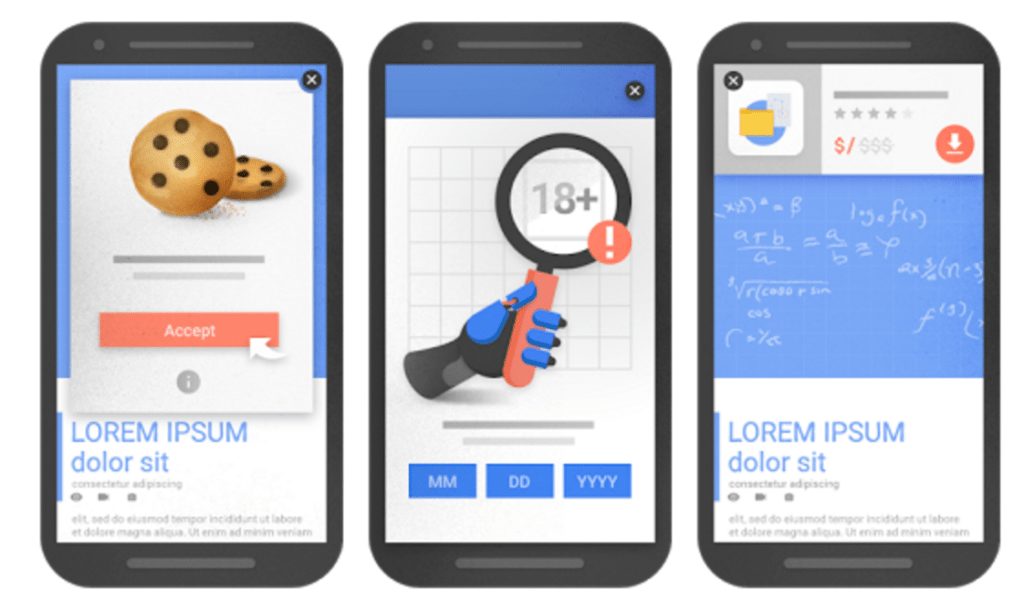
This move by Google should not be a surprise. After all, they are in the business of delivering high-quality content to their customers. No doubt, obnoxious pop-ups deter from a quality user experience in most cases.
That depends on what you are using them for. If you are using pop-ups that are within the bounds of what Google has said is acceptable for mobile usage, then you are in the clear.
If you are using pop-ups as a tool to generate subscribers or opt-in to a sales funnel, I do not recommend using mobile pop-ups. In my opinion, Google has indicated that this is a red flag, which will more than likely hurt your mobile search rankings.
In my opinion, pop-ups can be an effective tool when used wisely to add to user experience. The flippant use of pop-ups will negatively impact a website visitor's experience with your brand.
There are many digital marketers who advocate the benefits of pop-ups, while others loathe the practice. Do your research and determine if leveraging this marketing tactic is right for your brand or not. If you are using data to help you make marketing decisions, you will quickly know if it is an effective strategy or not.
This move by Google further signifies that Google is serious about penalizing websites that do not provide a quality mobile experience. Regardless of what Google says, knowing that more people are searching on mobile devices than on desktops, why wouldn't a brand want to make sure that they have a quality mobile presence?
Google is going to continue to crack down on websites that are not mobile-friendly. This is a big deal! If your site does not provide mobile visitors with a quality website experience, give our team a call to discuss how to remedy this issue.

Copyright 2026 The Marketing Squad | Privacy Policy | Disclaimer | Terms of Service