In this week's podcast, we ask the question: Is marketing art, science, or a combination of both? During our discussion, we came to the conclusion that it is both art and science; however, you will want to hear how we came to that conclusion.
Our featured interview this week is with a very talented designer, Judson Kovasckitz. He comes from a family of designers and loves creating art in a variety of mediums. Not only is Jud a great artist, he is also a podcast junkie and shares his love of podcasts.
As always, our conversations are filling with fun conversations and unexpected rabbit trails. You definitely want to hear Jud discuss how he believes virtual reality (VR) technology is going to become mainstream in the next few years and how marketers may be able to harness this emerging technology.
[smart_track_player url="http://traffic.libsyn.com/catalystseven/WSB_Squad5_Is_Marketing_Art_Science_or_both.mp3" social="true" social_twitter="true" social_facebook="true" social_gplus="true" ]
Want to be a guest on Winning at Small Business? Click here to learn more.
Do you have a question for us? Click here to send us your question.
The Compound Effect by Darren Hardy
Click here to download our Free Digital Marketing Reporting Template
We've had a lot of activity around The Squad lately. A few weeks ago, we hosted our open house and ribbon cutting to officially mark our rebranding as The Marketing Squad! Among office happenings, I'm down South this week for my wedding and honeymoon. Needless to say, there have been many distractions in the office, as well as outside.
You may be wondering how I manage to keep my head on straight with all of this activity. I can sum it up in one sentence: Organization is key.
Staying organized prevents things from piling up and the stress monster from creeping out of the closet and destroying your productivity! Keep that guy locked up, because in this rat race, ain't nobody got time for that!
In order to maintain my organization skills, I have a set of tasks I work through at the end of each day, before leaving the office. Believe me, some days, the last thing I want to do is prepare for another hectic day. But I know that if I exercise self-discipline and simply knock it out, I will be much more productive at the start of the next day. Analyzing what has been accomplished today in preparation for tomorrow helps me realign my focus and spares me my mornings. Here are four things you should do before leaving the office each day:
There's no need to reinvent the wheel. Grab 3-5 priorities and write them down on paper. Off to the side, make a second list of other important items that should be completed that week, but aren't top priority. After you have your priorities listed, make sure they are feasible. It's easy to feel ambitious before the rat race of the next day begins, but hold your horses. Overloading yourself won't solve anything.
Mapping out your day saves crucial morning minutes when many of us are at our productivity peak. It's a relief as you turn on you computer and realize your route for the day has already been planned. Then, you can put those morning planning minutes towards accomplishing priorities.
Have you ever looked at everything you had to accomplish and want to scream? It happens to the best of us. BUT if you have those super rad lists made up, you will never wonder what your priorities should be. In the event you find yourself with an extra-long list, let's say because you are getting married in a few days, take a few extra minutes and analyze your tasks. Are there items that can be accomplished fairly quickly?
David Allen, a productivity genius and best-selling author, has a two-minute rule which I have come to know and love. He sums the Rule up perfectly in this statement, "If you determine an action can be done in two minutes, you actually should do it right then because it’ll take longer to organize it and review it than it would be to actually finish it."
It's as simple as that. If there is a series of tasks that can be knocked out in a few minutes, just get them done and move on to more complex items. Which leads me to my favorite part: Check that task off!
How many of you write down a previously completed task just to check it off? Guilty! Just get that lingering "to do" off of your list. Lingering items on your task list are a visual and cognitive distraction, preventing you from seeing what actually needs to be accomplished. Visual reminders are the best reminders.
Yup, go ahead and check out your schedule for the next day. I know, it's kind of scary sometimes. But taking time to review your day before it actually begins gives you time to prepare for what's headed your way. Have a big client meeting? An internal discussion? A brainstorm? Flying by the seat of your pants for these things isn't productive and can be really frustrating for everyone involved. Reviewing these meetings prior will also allow you to prepare in a calm and thoughtful manner.
While you're at it, go ahead and review your team members' schedules if you have access. This way, if you need to have a quick discussion about an upcoming deliverable you aren't bombarding them with questions that you could easily find yourself. So, review their schedule and send them a quick invite for a 15-minute meeting. No confusing conversations. No "lemme get back to you." Nope. Just pure and wonderful organization.
I get it. It's easy to let emails build up over time. But without a solid process to organize said emails, you will end up with an inbox full of 1,128 unread emails. And that's cray cray.
Here's my process: When I receive an email, I do not open until I am ready to make a move, meaning either putting it on my to-do list or accomplishing it. Checking email frequently and efficiently, as mentioned, prevents the pileup. After it's completed, I file it under the respective client folder in Gmail or delete it if necessary. This way, I can always refer back to what was needed or quickly respond to the individual.
Since I am constantly adding things to my to-do list, it only makes sense for me to reprioritize at the end of each day. I can reflect on what I accomplished and what should come next tomorrow.
Tasks like these keep the train moving even when the load is a little heavy. Now, if your task list is bogged down by all that marketing stuff, give us a call. We can help you lighten up your task load and help you focus on your business, while we take care of your marketing.
As an Account Manager, it's essential that I get to know my clients, from their business to their industry and everything in between. There is always a learning curve in the beginning because I'm getting a crash course in everything about them. Especially how to represent them - this could be their products, voice, or even the latest industry trends.
We do a lot to learn more about our clients and are constantly improving on how we can serve them. We have industry article channels that we follow for clients, we will subscribe to newsletters, and I can't even begin on the countless hours of research I do for each client. But learning about clients is what I love most about my job. I love learning more about the businesses, industries, and clients. I love learning as much as I can. Despite all the research I do; however, there are some things I cannot teach myself.
We always strive to be the best, but there's one thing we cannot deny - we are not immediately experts on your company, clients, and industry - you are and we want to learn from you. In order to better understand it all, here are five ways that really help us learn more about you, which enables us to better represent you.
1. Taking a Tour. If you have a production plant, then we can tour that and learn more about certain pieces of equipment, learn more about what you do, and how you do it. If you have an office where all the magic happens, let us sit in and watch for a while. The more we see and learn more about you, the better we can represent you. I walk away from plant tours with my head reeling with ideas - it's by far my favorite way to get to know clients. Afterward, I write down pages of information, blog concepts, and social ideas. I also get a deeper sense of your culture, capabilities, and expectations.
2. Client Interviews. Let us interview 3-5 (minimum) of your "perfect" clients. Interviewing your clients lets us learn more about their likes, dislikes, where they get information, and so much more. There's no such thing as knowing too much about your clients and target markets. Once you know all this information, then we can target the copy, website layout, user experience, social media, and other marketing aspects to your target audience. Targeting your market or audience in an informed way leads to a greater message and overall success rate.
3. Sit Down One-on-One. If I can sit down with you and really talk with you, hear your history and passion, and learn about how things are done, then that tells me more than an emailed leaflet any day. Don't get me wrong, those are good too, but a sit-down always says more. That's why people typically want to do sales in-person, right? One-on-one, you can answer my questions and I can address concerns or confusion.
4. Weekly Check-ins. Weekly check-in calls are typical for our Partner Clients. In a 15 minute call we learn the latest happenings in your company (did you win an award, going to a conference, or want to push a certain product next week?), we can collaborate as a team to see what needs to be done, short-term and sometimes long-term goals, analytics, and other marketing considerations. With weekly info sessions, there's no way we can't deepen a relationship and get to know you better while learning how to serve you better with quick-turning capabilities.
5. Open Feedback. Please be candid in your feedback. I'm not going to be perfect right off the bat. Tell me what is wrong and how I can improve. With the open feedback, you can help me write the way you want and focus on marketing aspects that are important to you. I'll also feel like you'll be receptive to our recommendations to help you.
Anytime you start a relationship, there is some learning time. You learn about our crazy lingo, my personality, how our company operates, and how we can help you. While that is happening we delve into every aspect we can to best represent you. Want to learn more about our processes? Check out our website and our blog. Or if you want to just skip to the introduction, contact us here. Have your own suggestions on how we can get to know you better? Comment them below!
At The Squad, we like to meet with our program clients once a month and talk through how things are going. It is safe to say that in the first few meetings with a new client, we do a lot of educating on common marketing terms. If you plan to do work with us in the future or would just like to have a better knowledge of basic marketing lingo, this blog is for you. By the end, you will know what we mean when we say CTA, PPC, SEO, content offers, and long-tail keywords. You may even learn a little bit about why these tools are useful for getting your brand or product seen in the digital world.
When you come to us for a polished new website, we are going to ask you to help us create around five strong CTAs. Let me break down what these are.
CTAs are Calls to Action.
When someone lands on your site, it's likely because they have read something of yours that helped them make an informed decision about your product or at least interested them. Once they reach your site, your job (or our job) is to make it as easy as possible for them to take the action that you are wanting them to take.
Do you want people to schedule an appointment? There should be a CTA that reads "Schedule an appointment here" on your home page. If you offer additional services, we will create CTAs to attract the attention of potential customers who are interested in learning more about those services. CTAs are like right hooks in boxing, and you need them to be there at just the right moment to win in the marketing world.
You can also have CTAs for when your potential customer/client is still in the research phase. The research phase is when prospects are still deciding on what product or service to go for. We can create a CTA asking the visitor to download a white paper on the pros and cons of your product or service. Helping your customer builds trust that goes a long way when they are finally ready to make a purchasing decision. When the time is right, they will be more likely to pick you!
To get a better idea of different types of CTAs for different groups of people that come to your website, check out this blog from HubSpot.
SEO is Search Engine Optimization.
Search engine optimization is what we do with your site to make sure that Google recognizes it as an authority. If you utilize SEO properly, your website will be found when people are searching for your product or service on search engines like Google and Bing.
There are many factors that play into SEO that would be exhaustive to list here, but if you do work with us in the future, you will definitely hear more about this word and strategies for optimizing your marketing plan.
Here's another acronym for you.
PPC stands for Pay Per Click.
This is important when we are doing Google ads for your company. We begin by conducting SEO research to determine what keywords people are searching for in your industry, and then we help you budget accordingly so that your site gets found when people are searching for your product or service.
If you sell Biewer Yorkie show dogs in Louisville, you will want your website to be on the top of the list when someone Googles "Biewer Yorkies Louisville" or "Biewer Yorkie show dogs."
By digging into Google Analytics, we can find out how much each click to your website is going to cost you when people search particular keywords. Then we can together determine the keywords that you want to put money behind.
Long tail keywords are important when it comes to how Google ranks your page. They are also important for SEO or Google Adwords.
A long tail keyword is a phrase that is the focus point of a blog that you write and/or a page on your website.
Continuing with the dog example above, the breeder would use the long tail keyword "Biewer Yorkies for show," and try to make this the focus of many pages on the website. This is so the show dog breeder will be found when people are looking to buy a new biewer to raise and train for show. The main keyword or topic "yorkies" is not specific enough. By using "Biewer Yorkies for show" as the long tail keyword, people who are searching will find exactly what they are looking for on the breeder's page. Be sure to use long tail keywords like this example to make sure your potential customers can find your business when searching for your products or services.
The purpose of a content offer is to provide something valuable to your potential customers or clients in exchange for a small amount of their information.
For example, the breeder could create a content offer "The 10 Most Important Qualities Your Biewer Needs to Win Best in Show," and require that a first name, last name, and email address be provided in order to download the guide. With this contact information, the breeder could then send a follow-up email with pictures of the new litter and a personal invitation to come meet the puppies.
These are just a few terms that are used often around The Squad. Please leave a comment below and let us know of any other words that you would like some clarification on, and we will be more than happy to write a Part 2 on the Marketing Lingo!
In this week's edition of Winning at Small Business, Joel and I discuss how Twitter's recent update to the 140 character limit will impact marketers and discuss strategies to increase the lead generation performance of digital marketing campaigns.
Episode Content
Recommended Reading
5 Dysfunctions of a Team by Patrick Lencioni
Ask a Question
Do you have a sales, marketing, business development, or entrepreneurship question for our team? Click here to send it our way.
Listen to the Squadcast
[smart_track_player url="http://traffic.libsyn.com/catalystseven/WSB_3_Bryce_Raley-_92216_3.22_PM.mp3" social="true" social_twitter="true" social_facebook="true" social_gplus="true" ]
Generating leads via your website is a multi-step process. Getting a prospect to your landing page is the easiest part in this endeavor. The difficult part is motivating a prospect to enter the sales funnel by filling out a form or initiate a call (with a call tracking number of course).
Based on my experience and research, there are three key elements that must be carefully addressed in order to improve landing page conversions.
First and foremost is the call to action (CTA). If the CTA doesn’t connect with visitors, your form will not convert. The call to action must meet the following criteria:
By the way, stay tuned for my next blog post about how to create a high-impact CTA! There is not enough room in this post to dive deep on this important topic.
I am frequently asked about the best place to position a form on a landing page. You are not going to like this answer, but it depends on a variety of factors including:
For example, if I am trying to get a person to sign up for a webinar, a standard landing page layout with a content section and a sidebar form will more than likely suffice.
However, if I am trying to get a person to purchase a $299 online sales training course, a standard landing page layout probably won’t work. In this situation, I would recommend a long form sales page with multiple benefit statements, social proofs (testimonials), content teasers, sales hooks, and conversion paths (forms).
Both of the examples listed above have proven to be successful when deployed properly. This is why landing page design is so important. All landing pages are not created equal.
Just for fun, I often hear that landing page conversion forms have to go "above the fold." Really? Why? What does that even mean anyway?
With the meteoric rise of mobile users, the term "above the fold" has almost become obsolete in digital marketing. People are used to scrolling down a web page to find or consume the information they are looking for. This is currently true on desktop, mobile, and tablet devices.
I am more concerned with telling a story that draws a prospect in and motivates them to take action at the appropriate time than putting a form above the fold.
In this instance, less is truly more. I want it to be as easy as possible for a person to complete a form and get the information they are looking for. Of course, this also depends on what the offer is. For example, when we use an email opt-in popup on our website, I want it to be super easy and fast for your to sign up. All I need is your email, first name, and last name (we separate out first and last name so we can personalize every email you receive from The Squad.)
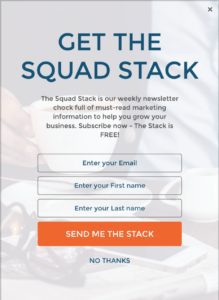
If you are providing an in-depth whitepaper or some other high-level content offer, asking for additional information is acceptable. Get as much information as you can without creating too much form friction. In this particular case, asking for the following information would be reasonable:
Unless your landing page is set up to be an order form, don’t treat it like one. The purpose of a landing page is simply to get a prospect into the sales funnel so you can initiate future touch points.
Do you have a specific question about form field elements? Send us an email via ask@themarketingsquad.com or on Twitter (marketing_squad) with the #askthesquad hashtag.
Building impactful landing pages with high converting forms is an art and science. It requires a detailed knowledge of your target audience, creativity, and a committed approach to test and measure. Trust me, not everything you will do in marketing works on the first try. It has to be refined through a data-centric measurement process.
If you need help improving the quality of your landing pages, contact us at 502-618-4230 or click here to schedule a free initial consultation with one of our solutions consultants.

Copyright 2026 The Marketing Squad | Privacy Policy | Disclaimer | Terms of Service